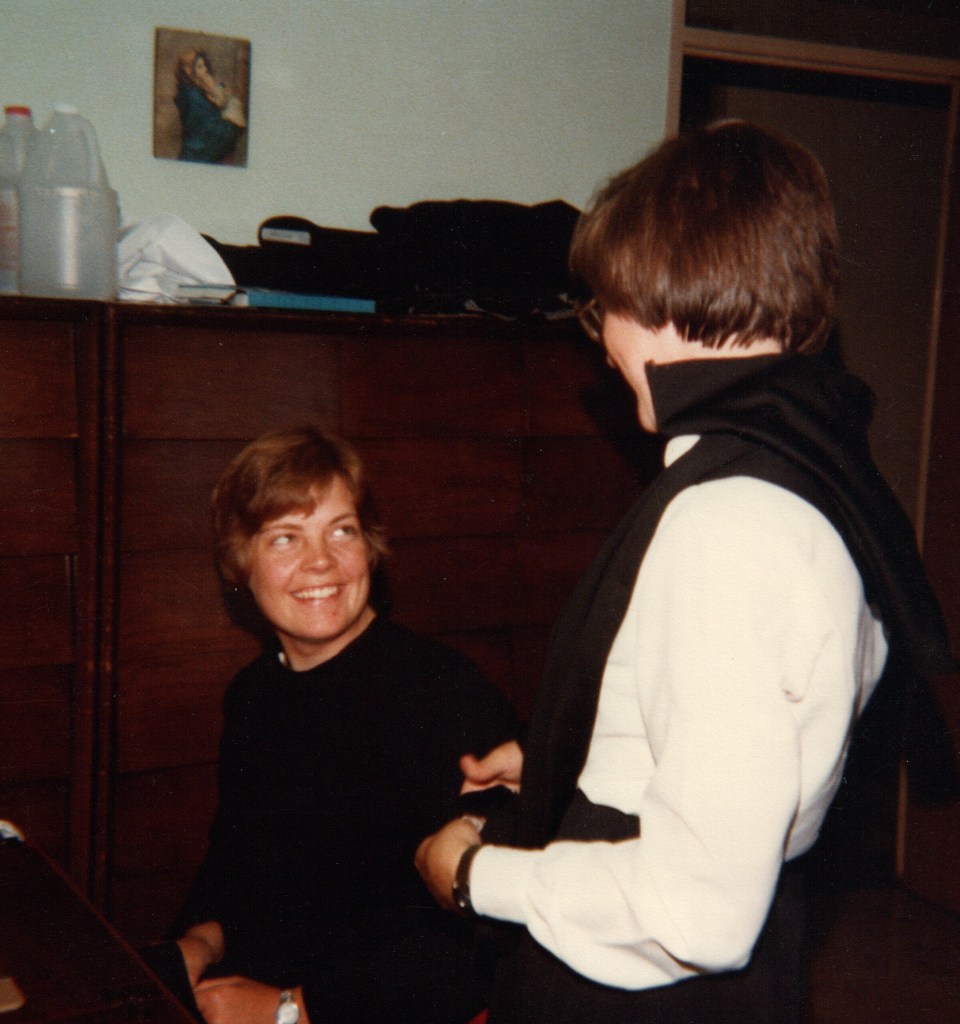
First Vow ceremony August 15, 1987 with my classmate, Carol Hendricks
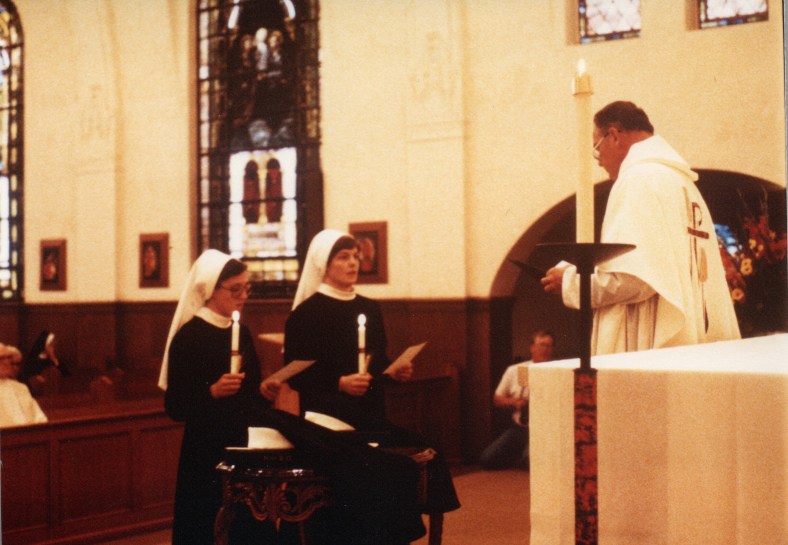
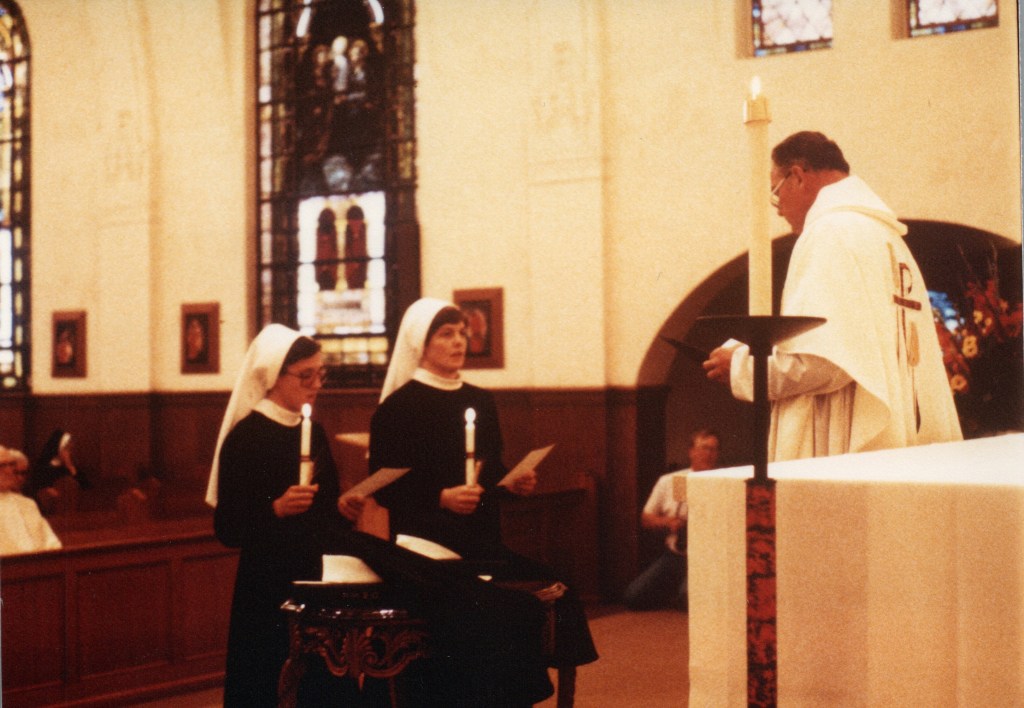
Two and a half years after entering religious life with the Sisters of St. Mary of Oregon, I wrote a handwritten letter to the Superior General, Sister Fidelis Kreutzer to ask permission to make first vows. My request was granted and on August 15, 1982, the Feast of the Assumption of Mary, my friends and family joined me for a very special day in my life.
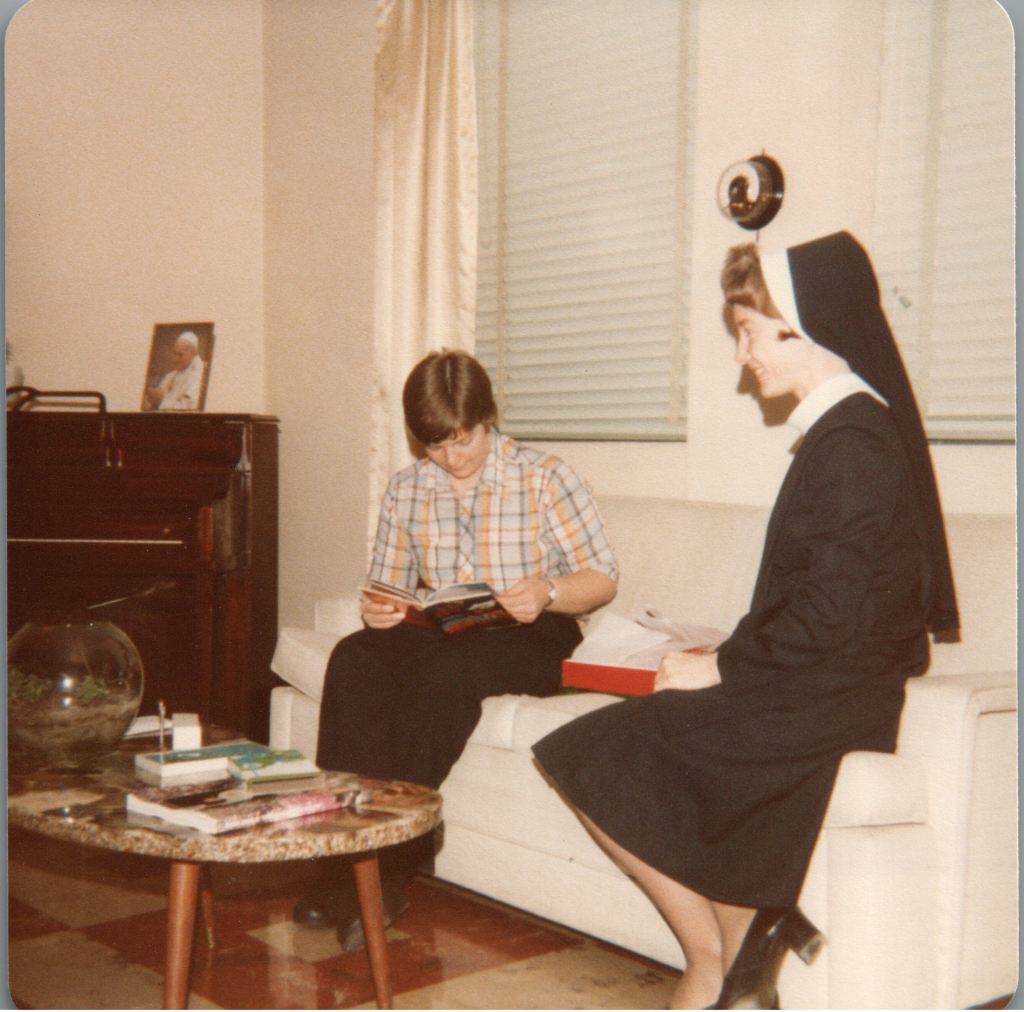
Pronouncing my first vows with the Sisters of St. Mary of Oregon Aug. 15, 1982
These temporary vows, commonly called first vows, are canonically binding for a particular length of time, often ranging from one to three years. During this time, the sisters engage in ministry and live in community. At the end of this period, the vows can be renewed.
After my first vows, I continued to teach at St. Mary of the Valley High School (Later named Valley Catholic). I was still taking classes at PSU and classes in Formation. Life was great. I was getting into the groove of education and I was very busy. I enjoyed learning and I enjoyed teaching. Life of Christ was the religion class I taught, and sophomores took my class. I started helping Sister Catherine Hertel on her high school retreats. I was quickly getting involved in activities and I liked it. The students at the school were great people from wonderful families. I felt blessed to work there.
During my canonical year, that streak of fun came out in me and I couldn’t help myself. I had tasks that required me to go between the men’s shop and the garage. There was a garage door opener in the men’s shop and I often had it in my apron as I took wood back and forth. One day, one of the elderly sisters was standing near the garage door and I showed her how I could kick the drainpipe and the garage door would go up. Actually, I was clicking the clicker in my pocket. She was thoroughly amazed. After I had my fun, I went on my way just as one of the more boisterous Sisters drove up to the garage. Sister Thomas called me back to show Sister Elma what I could do. I was all too happy to go back and do it again. I kicked on the drainpipe and up went the garage door. Kicked it again and down it went. Again, thoroughly incredulous at this demonstration.
About that time the men came out of the shop and Sr. Elma motioned them over. She encouraged me to show them what I could do. I kicked the drainpipe and up went the door. The head of maintenance kicked it and down it went. He kicked it again up it went, kicked it again started to go down then overheated. Then he kicked in between all of the garage doors (6) to see if there were any similar issues. Then he started talking jack hammer to open up the area behind the drainpipe to see what was going on. Uh oh…I waited till everyone left then I went out to the shop and told Dave I had the clicker in my pocket and was fooling the Sisters. He hung his head, didn’t have to say a thing, and I felt bad I had sort of humiliated him.
OK time to self-report. I went to Sr. Fidelis and told her what I had done. She of course laughed and enjoyed the story and told me not to worry about it. Whew! The story made the rounds. About two weeks later, one of the Sisters was seen kicking the drainpipe trying to get into the garage. Sr. Thomas saw this happen and told me about it. Sister Dismaria had been watching from second floor of the convent out the window and surmised the garage door would go up if you kicked the drainpipe. She did not hear the rest of the story and figured it would not have been fixed yet. She just couldn’t seem to find the right place to kick!
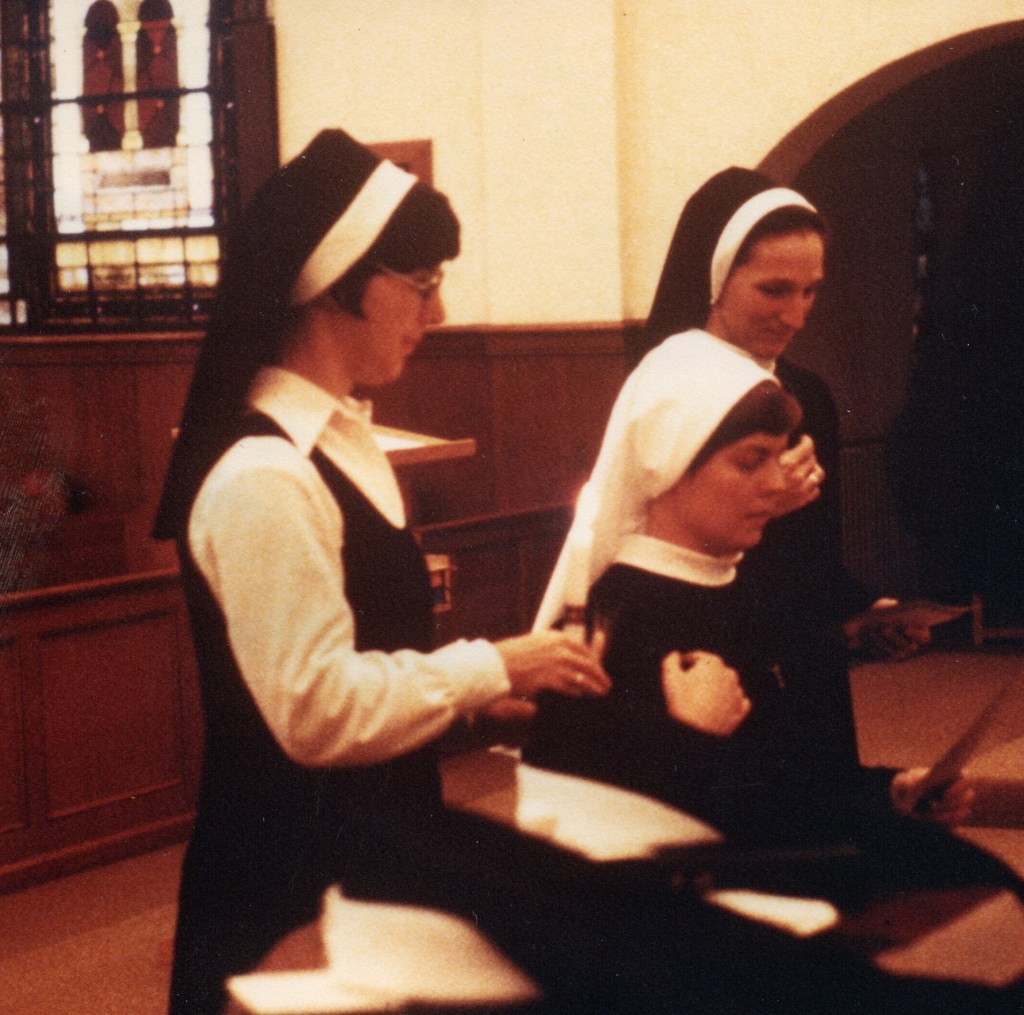
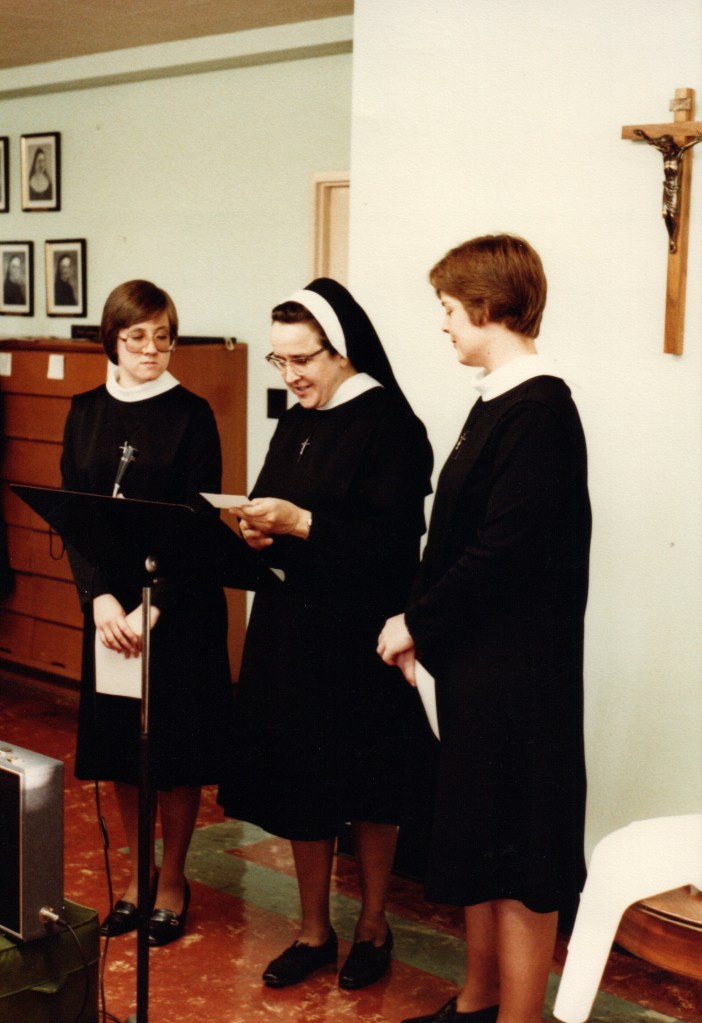
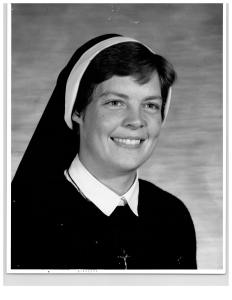
Sister Fidelis Kreutzer gives an inspirational talk before giving my classmate and I our white veils.
My Canonical Year
I talked about “Formation” in an earlier piece as a time of discernment before making final vows with the Sisters of St. Mary of Oregon. This process can take seven and a half years in our community. After finishing six months minimum as a “candidate”, I wrote a handwritten letter to ask to become a novice with the community. This then began a two year “novitiate” and for the first time, we were then referred to as “Sister.”
The first year of novitiate is generally referred to as a “Canonical Year.” This year is dedicated to prayer, studying all aspects of the vows and really learning about religious life and the unique charism or spirit of the community. The second year of the novitiate is often spent in furthering education or ministry. In my case, I entered after college but went on to get a fifth year at Portland State while teaching part time at the high school and engaging in formation classes at the convent.
I clearly remember the gift of my canonical year as I had the time to think, pray, work, study and come to really know the community. Some interesting aspects of the year included ringing the electric bell which reminded us hourly to say a prayer and turn our thoughts to God. The switch for the bell was located in chapel and I had to remember to ring it on the hour. I found a simple egg timer to remind me as it was well before I phones with timers!
Canonically, most of our time was to be spent at the Motherhouse and we could make few trips outside to do things. It was a year set apart, a special year and not one that was to be in competition with the distractions of the world. I did not listen to music, watch TV, or go to movies that year.
I cleaned the tables in the grade school cold and hot lunchrooms after their lunch each day which gave me an opportunity to meet people who taught or worked at the grade school. My classmate and I also led a rosary every day at 1:00 to pray for vocations to religious life. The elder Sisters would join us in the chapel.
We learned all aspects of setting up for Mass each morning. The Sacristan would teach us everything about the liturgical seasons, the rites and rituals and it was our job to carry it out. It was very interesting to me and I appreciated this knowledge.
There were many projects we were kept busy with during that year along with formation classes, writing papers on the vows and deepening our prayer lives. By the time the canonical year was finished, we had a sound foundation about religious life, the sisters, prayer, the ministries of our community and much about ourselves.
Carol and Krista begin the candidacy phase of religious life with the Sisters of Sr. Mary of Oregon in February of 1980.After being accepted in a ceremony as a “candidate”, Krista is welcomed and hugged by Sister Fidelis Kreutzer. Superior General (1980) of the Sisters of St. Mary of Oregon.
Before officially entering a community, a woman will spend 6 months to a few years while she and the membership get to know one another. Our community calls this stage “candidacy,” while when I entered it was called “postulancy.”
I entered in February of 1980 and wrote a handwritten letter prior to August 15, 1980 to request admission into the novitiate. Sister Fidelis Kreutzer was Superior General (leader) of our community at that time and was a very special person to me.
As a “candidate” I spent the next 6 months helping out wherever needed, was given a schedule of projects to accomplish and started at the very basic level of getting to know what this life was all about. I started wearing a black skirt and a white blouse. I did not wear a veil and I was not called, “Sister.”
I had a classmate, who joined with me and we were a team figuring things out together. She had just graduated from high school and me from college. Little did we know the exciting things that lay ahead for us. I was ready!
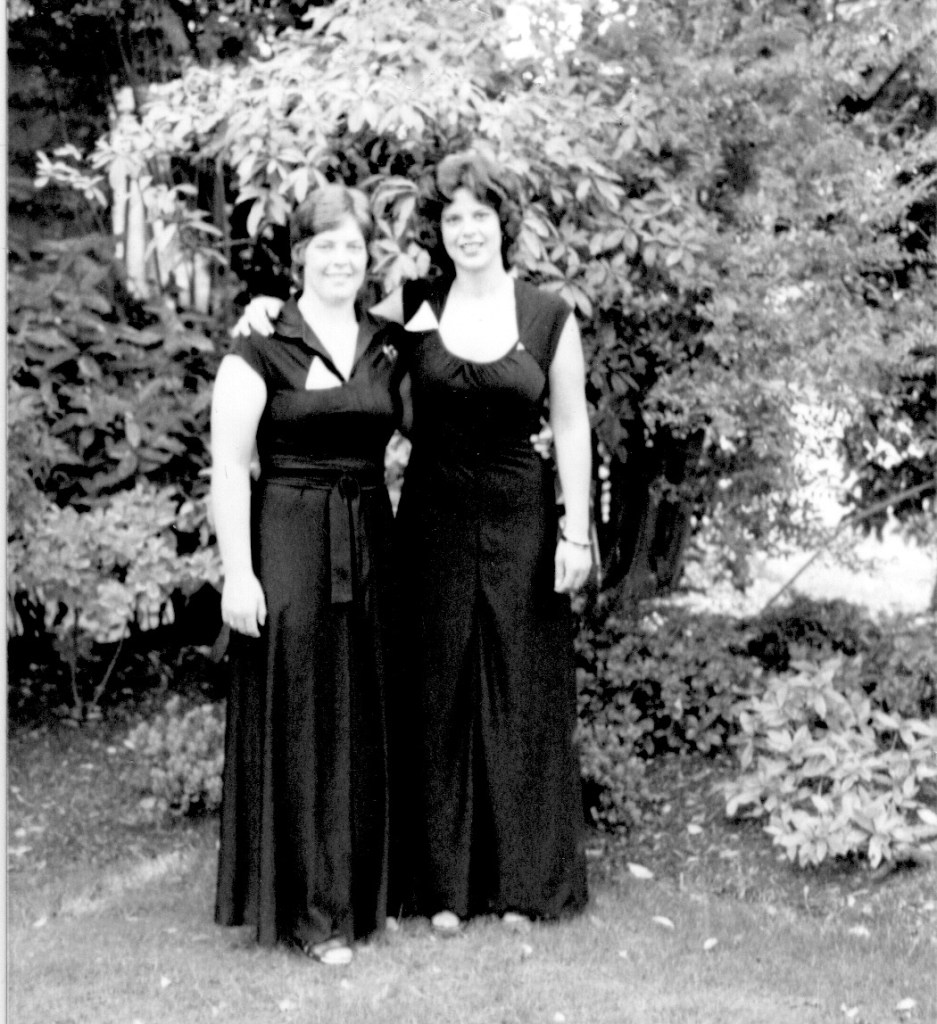
1979 Krista and blood sister, Karla von Borstel at Sigma Kappa, OSU
A former student texted me the question, “What qualified you for work at Boeing and why did you choose religious life over Boeing?”
Great question and one that many people in my situation may struggle with. Returning to that religious experience I wrote about earlier this week where I realized the importance of and shortness of a life, I reflected with Sr. John Therese about my decision to go to Boeing. In my mind I knew there was the possibility that once I got wrapped up in work and life at Boeing, the convent would become a thought of the past. Was it worth risking the opportunity and desire I had always longed for, to live a religious life? It did not take much wisdom from Sr. John Therese for me to see the value in making a decision to enter the convent.
The thought of working for Boeing as a college graduate was very enticing to me. My degree in Industrial Arts with studies in mass production and process management were particularly desired at that time and they contacted several of us at the University to consider working for them. I had completed the extensive background check and was ready to go! Fortunately, I made that trip to the convent.
I have often reflected on how grateful I have been to have worked at Valley Catholic, CYO and Camp Howard over the years. I have always considered the kind of work I do to be “heart work”. A work that fulfils the heart and gives meaning to life. God is never outdone in his generosity to us or the plans he has for our lives. We just have to be willing to trust him and say “yes”.
In 1982 I began teaching at St. Mary of the Valley High School while also attending Portland State University to get my fifth year and participating in formation classes. I taught a couple of classes at the high school then went to PSU for the rest of the day until around 4:00 when I returned for classes at the convent. I was a busy little “first professed” as I continued to learn the ropes. I enjoyed teaching at the high school very much and could see myself full time in the future. I really appreciated teaching at our community high school.
My main assignment was to teach religion and I found enjoyment in coaching the jv Softball team. Prior to 1991, St. Mary of the Valley was an all-girl school which went co-ed and changed the name to Valley Catholic. My school experience as a youth had been co-ed and I was more at home in that environment. I think it is good for youth to be with the opposite gender at school while they have their feet under their parent’s roof. There are a lot of lessons best learned at home.
I realized how fortunate I was to be called to religious life and what satisfaction I got out of it. A religious who dedicates their life to Christ has the time to do things that a married person with the responsibilities of family would not have in many cases. I realized the many talents God had given me and I had the time to develop them.
23 days till National Vocation Awareness Week – post 3 of 25
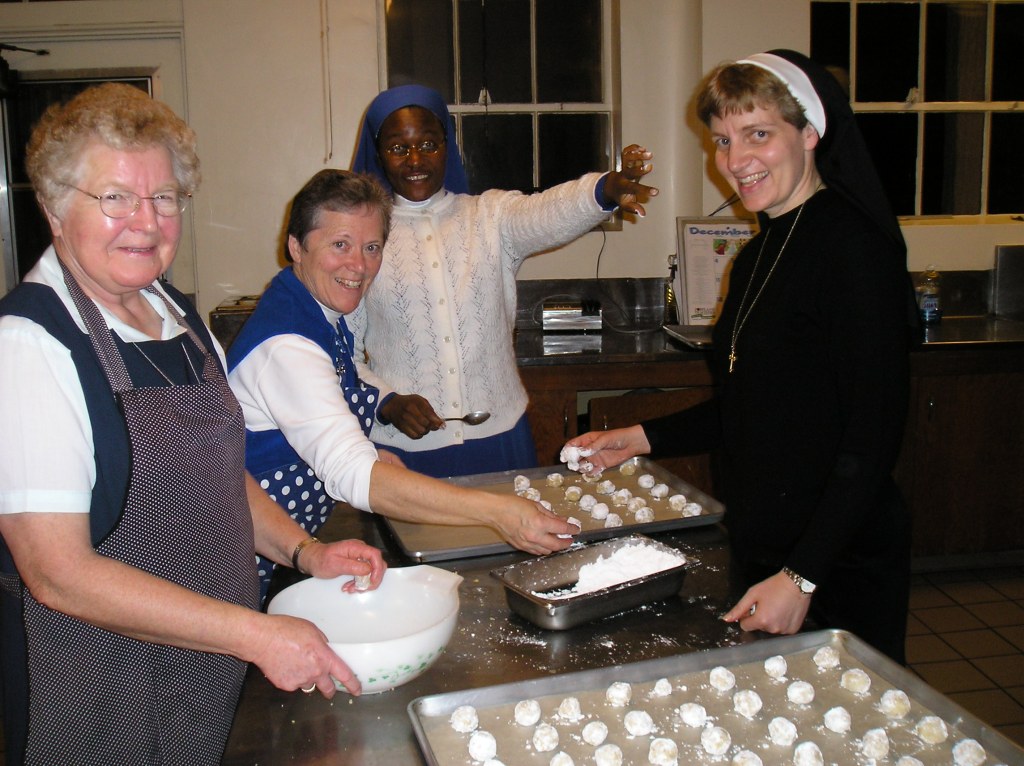
Preparing cookies for Christmas celebrations LtoR: Sr. Ruth Etzel, Sr. Maryann Giesel, Sr. Magdalene, Sr. Adele Marie
Fourty years have passed since I entered Religious Life. Things have changed as the world changes. Nothing stays the same and that is for the most part good, I think. Not in all cases but mostly. When I was in formation, we had what was called a “Rule of Separation” which mean’t if you were in formation you could not talk with the sisters who were professed. Why? You are probably asking? Formation takes place through the interaction with one formation director. Every single person has a suggestion for how something should be done. If you want a uniform formation for your members in religious life, best it be done through one, trained director. In my day there were a dozen of us in various stages of formation and we were able to create a good community of young sisters.
Today, we no longer have the rule of separation, but we do have 4 Sisters in formation, three of whom are under the age of 30. They are a wonderful group of young women who give me a lot of hope and confidence in our future as a religious community. The Sisters of St. Mary of Oregon accept women between the ages of 18 and 45. Even though we no longer have a rule of separation, the older sisters have an understanding of what should be deferred to the formation director.
My Journey to Religious Life by Sister Krista von Borstel – in preparation for Vocation Awareness Week I will write 25 short stories that paint a picture. 1 of 25
VOCATION APPRECIATION WEEK November 1-7, 2020 Countdown 25 days to go…I am going to start with my own vocation story. I grew up in Sherman County in Oregon (North Central) the second smallest county in Oregon next to Wheeler! I remember having a very serious religious experience as a very young person where I realized how short life is and how important it is to make the most of it. This inspiration hit me at my grandfathers funeral, it was also the first funeral I remember. About two years later I went to my first “CCD summer classes” taught by Sisters of the Holy Names in Grass Valley. I knew at that moment (third grade) that I would be doing that some day. Still amazed by that insight. I liked what they were doing and I was inspired to want to do it too. The thought lay on my mind the rest of my youth and through college. Though I dated in college, I knew I did not want to get married because I wanted to enter religious life. I had not yet found the Sisters of St. Mary of Oregon. That happened my junior year when I met Sister Maureen Kalsch. We were taking a class together and met one day as we were checking our grades. I invited her to come to my sorority (Sigma Kappa) for dinner and she accepted. Later she invited me to make a retreat in Sublimity (near OSU) where I did go and meet several SSMO’s (Sisters of St. Mary of Oregon) Finally I was invited to make a trip to the Motherhouse in Beaverton and made another retreat. I loved it! When I finished college my Senior year, I had a job offer with Boeing which I had planned to accept in order to pay off my college debt ($2,000). I went to the convent and met with Sr. John Therese to tell her I was going to Seattle and accept the job with Boeing. Before I left the convent that day, I was going to enter the convent in February! A neighbor farmer, and close family friend, John Schadewitz, who was Baptist I might add, handed me a check for $2,000 to pay off my debt and the rest is history. I entered the convent February 3, 1980 with the Sisters of St. Mary of Oregon
For the past 150 years, the Catholic Sentinel has connected generations of parishioners to what’s happening in western Oregon and beyond with information that they trust. CYO/Camp Howard has partnered with the Sentinel since 1952, and ever since, we’ve delivered in print the excitement of CYO programs and the achievements of our kids to families, friends, and future campers and athletes.
Now, the Catholic Sentinel has added MySentinelNow – the free and complete digital version of each issue. Delivered to your Inbox, it’s easy to use and pages “flip” as if reading in print. Find CYO/Camp Howard sports and camp news wherever and whenever you want. Subscriptions are FREE – clickwww.mysentinelnow.orgto sign up.
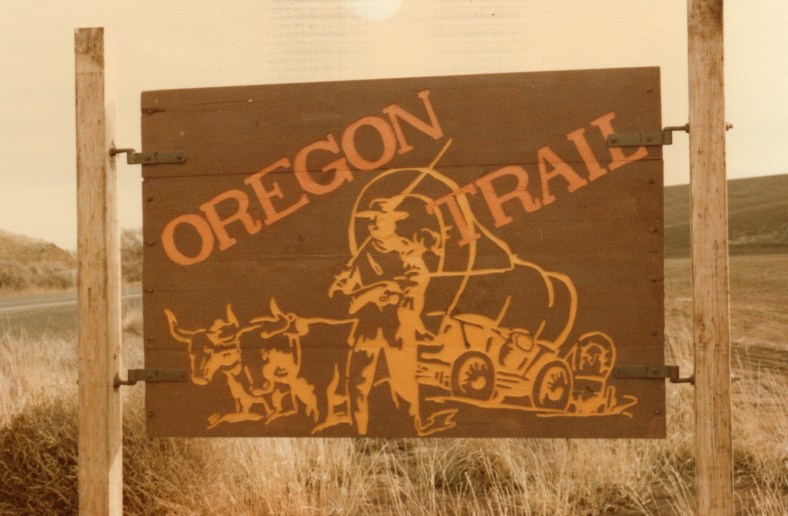
In December of 1979 I was asked to make a sign commemorating the area the Oregon Trail passed through Sherman County. I had just finished student teaching and had graduated from Oregon State University. I was waiting for February 3, 1980 to enter the convent with the Sisters of St. Mary of Oregon in Beaverton. A women’s group in the North end of Sherman County asked me if I would make a sign for them. I told them I would be happy to do it. It would be the last thing I would do before entering the convent.
I was living at home on the farm near Kent, OR the southern most part of the county. Wasco was toward the north end of the County. Sherman is the second smallest county in Oregon, only Wheeler is smaller in both population and acreage. The Columbia River to the north, the Deschutes to the west and the John Day to the East cut out the shape of the county.
I found several good pieces of Douglas Fir in the loft of the barn. Who knows how long it had been there. It was just what I needed as it was two inches thick, almost a foot wide and 5′ long. I laminated the pieces together with pegs and clamps to get them to the size I needed. I went to work hand routering the design onto the wood. After finishing, I painted it and finished it. The whole project took about two weeks to complete. I delivered it to the ladies in Wasco and they got one of the farmers to put it up. I saw it over the course of 40 years as I traveled home from time to time.
My cousin, Carsten von Borstel who lives in the county told me the sign had been reported stolen this fall. Someone had seen it in the back of a pickup truck on its way out of the county. There was a lot of commotion on the Sherman County Facebook page over the sign. People were pretty upset by it. No one really knew the details of the sign or how it got to mark the location. My cousin, Carsten informed them. I reached out and told them I would make a new sign. I am posting a photo of the old sign on this blog and at a later date will post the new sign. I have finished routering it on a CNC machine and am in the process of paining it now. It is a different design entirely from the first one. Stay tuned!
1980 Oregon Trail sign commemorating site in Sherman County, Oregon where the trail passed through the county.


 CYO/Camp Howard